In the clamor of early twentieth-century Milan, time became the ultimate commodity. The slow drip of classical brewing methods could no longer keep pace with the frantic heartbeat of Italian industrialization. What the public demanded was not merely a dark potion, but instantaneous rejuvenation. Thus began the quest to conquer the extraction of coffee through sheer force and atmospheric control.
The original breakthrough arose not from culinary refinement, but from thermodynamic necessity. Angelo Moriondo’s 1884 patent first harnessed steam to brew massive vats of coffee rapidly, yet it was Luigi Bezzera who realized that the extraction required a single-cup focus. Bezzera’s machine forced water and steam directly through tightly packed coffee grounds at roughly 1.5 bars of pressure, creating a dark, highly concentrated elixir. The drink was named for its defining characteristic: brewed espresso—expressly, on the spot, for the individual customer.
The Spring Piston & The Nine-Bar Boundary
While early steam-pressure machines revolutionized delivery speeds, they shared a fundamental flaw: steam burnt the delicate, volatile oils of the coffee seed. Brewed at temperatures exceeding boil point, early espresso was bitter, charred, and devoid of the silky, dense mouthfeel we celebrate today. The transition required an entirely different mechanical philosophy: separating heating from extraction pressure.
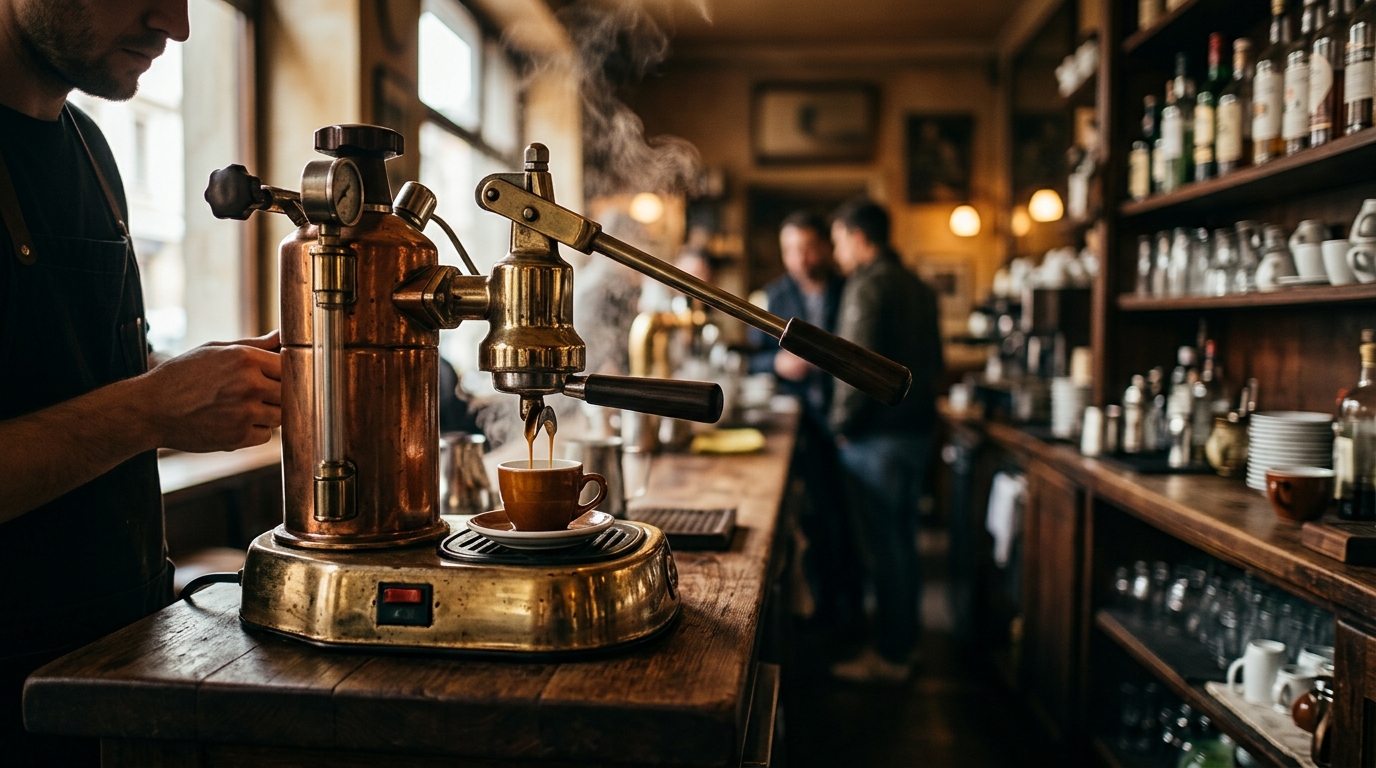
Enter Achille Gaggia. In 1938, the Milanese cafe owner designed a revolutionary rotary screw piston that bypassed the steam boiler’s pressure limits. Later refined into a spring-loaded lever system, Gaggia’s device allowed water to cool slightly below boiling, then mechanically pressurized it to a staggering nine atmospheres (9 bars). This mechanical leap yielded an unexpected, magnificent byproduct: a dense, golden-caramel suspended foam that Gaggia dubbed "crema caffe." Suddenly, the espresso was no longer just hot black water—it was a velvety system of emulsified oils and captured aromas.
"Espresso is a liquid solid. It is suspension, emulsion, and solution all bound in a fleeting, fragile thermodynamic equilibrium."
The Great Ritual of the Italian Bar
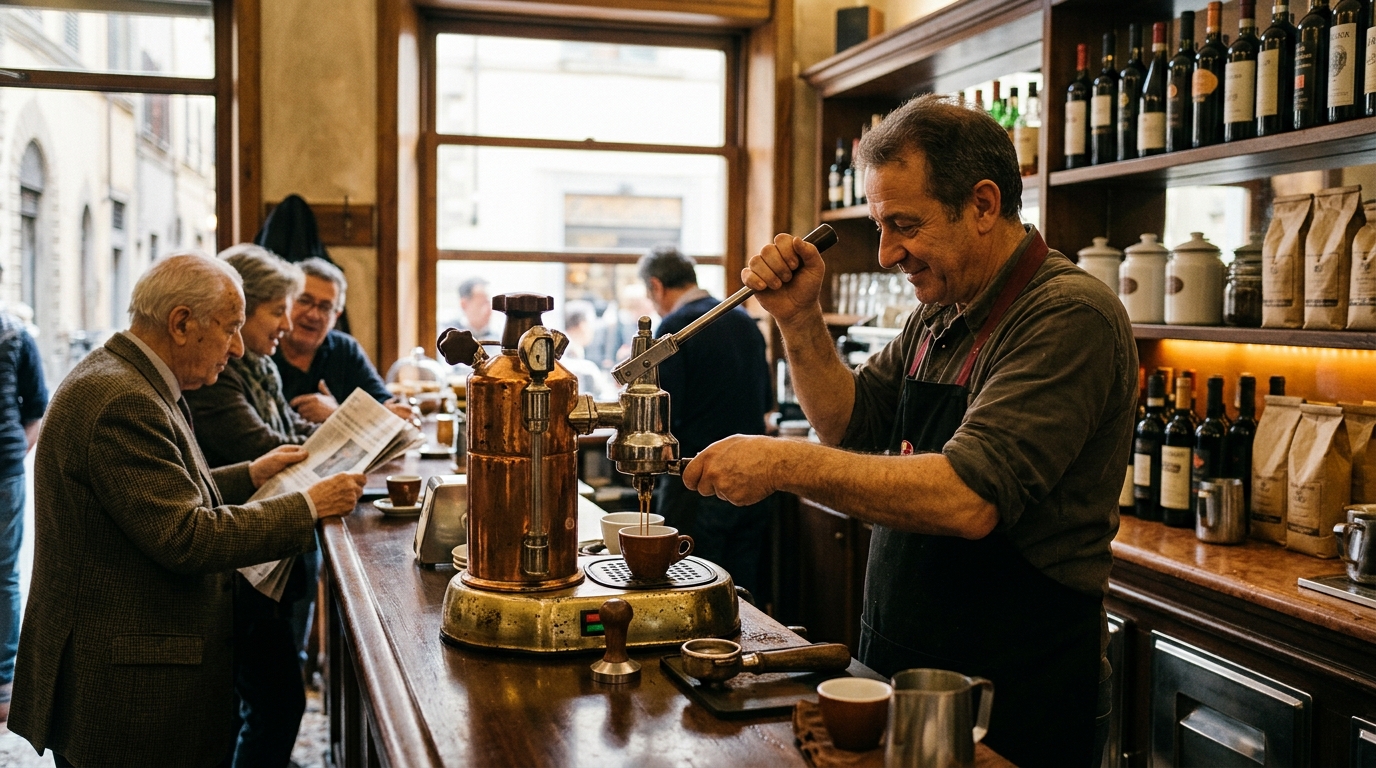
With the technical obstacles managed, espresso dissolved into the fabric of Italian social life. It transformed theater lobbies, public squares, and transit hubs into democratic exchange points. To drink espresso was to participate in a brief, standing performance—an exchange of copper coins, the hiss of the steam wand, and the rapid gulp of a warm cup completed in under sixty seconds.
In the neighborhood bar, class distinctions dissolved. The laborer and the politician stood shoulder to shoulder at the zinc countertops, united by a mutual understanding that coffee was a basic human right. This choreography of consumption defined the post-war reconstruction era, establishing coffee bars as communal living rooms where news was brokered and community was forged.
The Craft Revival & Modern Micro-Precision
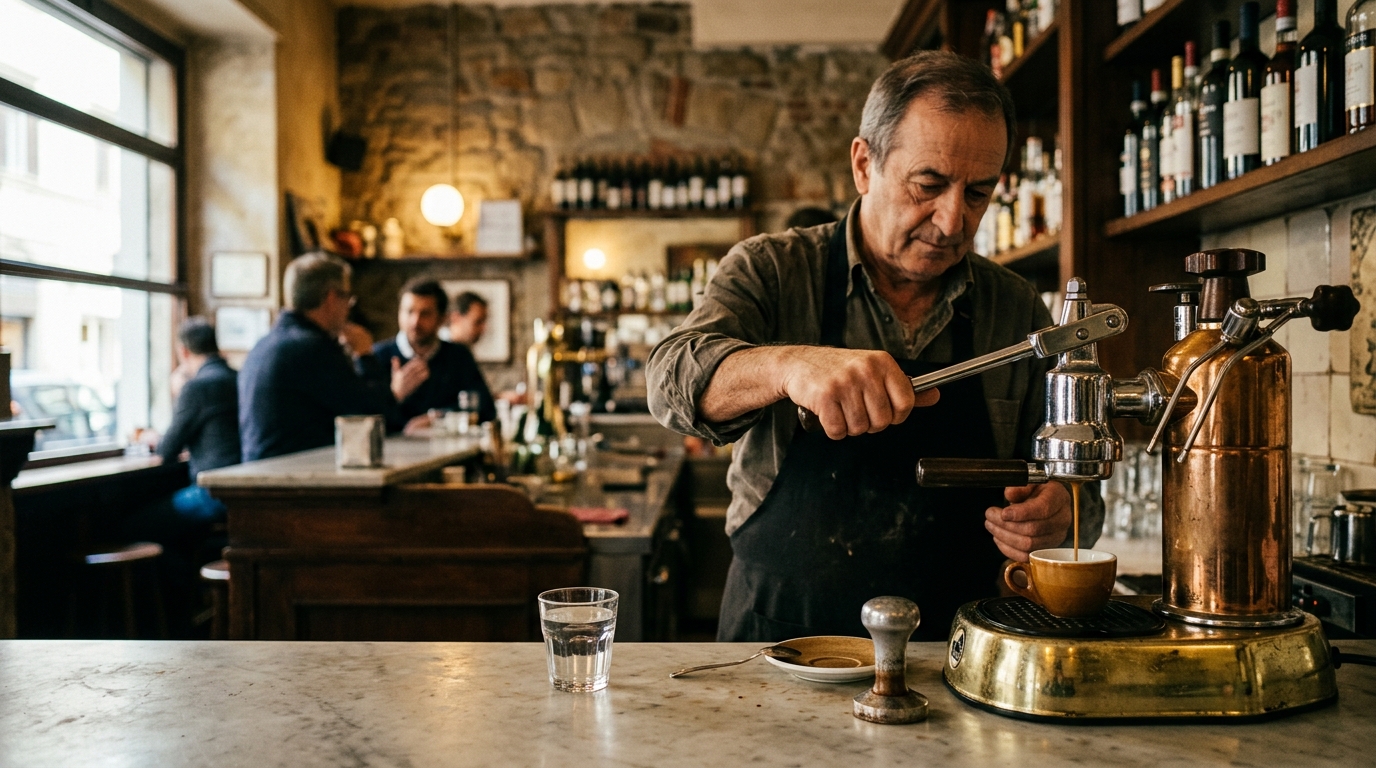
Today, we find ourselves in the golden twilight of the modern craft revival. The rise of third-wave roasting has elevated the humble shot from a dark commodity to a hyper-specific science. Scientists and passionate baristas map extraction yields with refractometers, trace individual cultivars back to precise volcanic microclimates, and sculpt water chemistry down to the part-per-million of magnesium and calcium ions.
From a 1901 pressure valve in Milan to a variables-guided profile on a contemporary bar, the essence of espresso remains unchanged. It is a stubborn, difficult pursuit to capture the absolute peak of a plant's aromatics, compressed through time and pressure, and poured into a single, perfect vessel.